
Nacogdoches County Sex Offender Checks
The Texas Public Sex Offender Registry is the principal free search for Nacogdoches County. Texas DPS manages the statewide public database under Code of Criminal Procedure Chapter 62. It supports person-based and place-based research, including name, address, city, county, ZIP code, and map options. The registry is a notification record for qualifying registration duties. It is not a complete criminal-history report and should not be used as one.
Nacogdoches County residents can start with a county filter for broad local awareness, a city or ZIP value for a smaller area, or a name when reviewing one possible match. Searchers should compare aliases, photograph, physical description, registered location, offense, and registration status before assuming two records concern the same person. Exact public labels can change, so the live controls govern.
See the official Texas public registry search source.
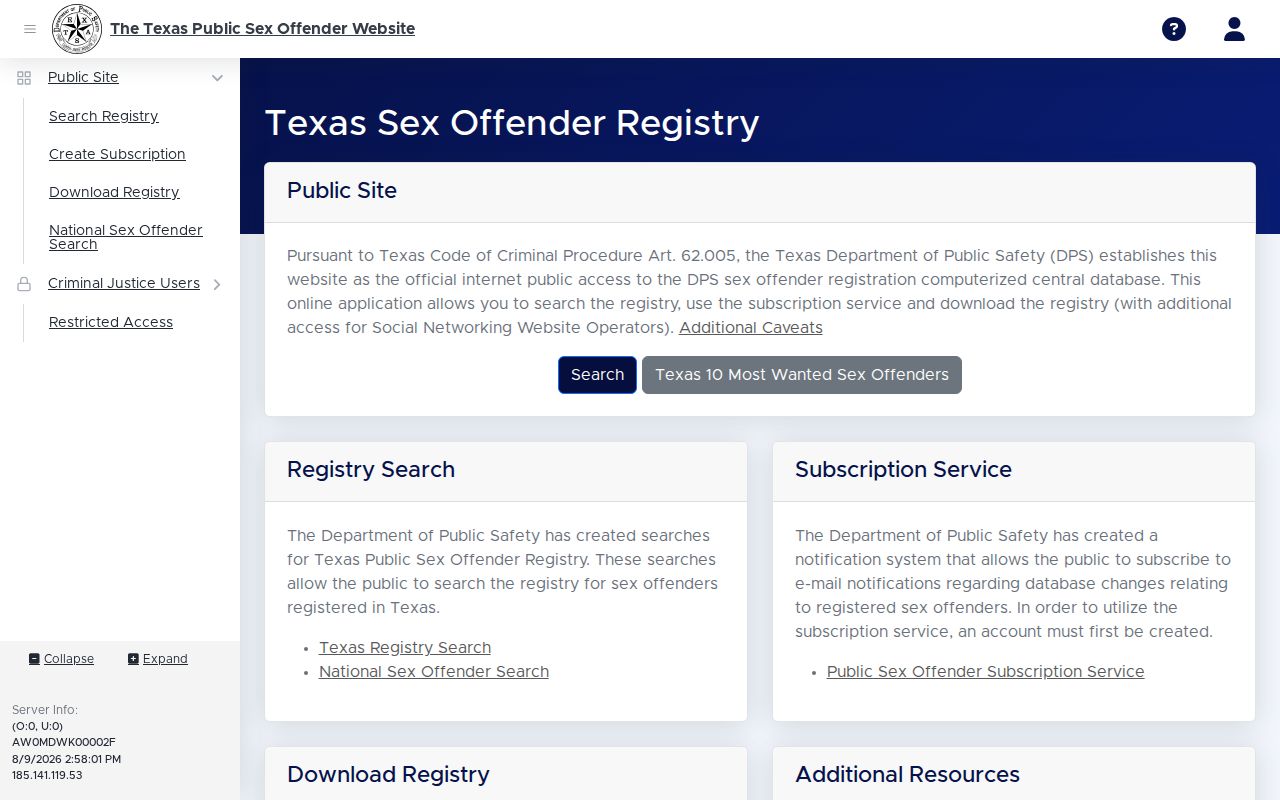
The registry image identifies the neutral search interface where Nacogdoches County name and geography checks begin.
Nacogdoches Police and Sheriff Registration Roles
Local authority depends on residence. A registrant living within a municipality generally reports to that city's chief-of-police authority. Someone outside a municipality generally registers with the Nacogdoches County Sheriff's Office. Local staff collect and verify registration information, then submit the data to DPS for statewide public access. Initial registration is due no later than the later of seven days after arrival or the first date allowed by the local authority's policy.
Questions about a Nacogdoches city registration should go to city police. The Nacogdoches County Sheriff's Office is the correct local contact for an unincorporated address. The official county directory should be checked for a current phone and office hours before contact, and the sheriff is located at 2306 Douglass Highway. DPS's Sex Offender Registration Unit handles statewide program questions at 512-424-2800.
No verified Nacogdoches County sheriff app with an app-only registry alert was found. Use the official DPS notification feature rather than attributing a third-party tool to the sheriff.
Note: City police and the county sheriff collect local registration data, while Texas DPS operates the statewide public search.
Texas Public Sex Offender Registry Searches
Open the official DPS search and choose the mode that fits the question. A name search is useful when the person is known. Address, city, county, ZIP, and map tools support community or neighborhood awareness. Start broad enough to catch a spelling variation, then narrow by reliable location and profile details. Notifications are a separate signup function and do not replace a fresh search when the current status matters.
- Open the DPS public registry and review its current conditions and warning.
- Choose name, address, county, city, ZIP, or map criteria that match the safety question.
- Review the result list, then compare aliases, image, physical traits, and location before selecting a profile.
- Open the profile and read the offense, status, verification, address, and registration details together.
The public interface offers several routes. No single field is required for every search mode, and the live registry may rename or move controls.
| Field or control | Type | Required | Use |
|---|---|---|---|
| Name Search | Tab or mode | No | Uses first and last name; try careful spelling variants |
| Address Search | Tab or mode | No | Checks street or address geography |
| City | Text or dropdown | Conditional | Use Nacogdoches, Garrison, or Cushing as appropriate |
| County | Dropdown | Conditional | Select Nacogdoches for a countywide result |
| ZIP Code | Text | Optional | Narrows the geographic area |
| Map Search | Map mode | No | Uses pan and zoom for place-based review |
| Search or Clear | Buttons | Not applicable | Runs or resets the current criteria |
| Notifications | Signup link | No | Provides access to the DPS notification function |
NSOPW Beyond Nacogdoches County
The National Sex Offender Public Website, maintained as a U.S. Department of Justice resource, adds a cross-state search layer. It is useful when a person recently moved, an address lies near a state line, or the relevant jurisdiction is uncertain. NSOPW searches participating public registries, but each state remains responsible for its source data and public rules.
View the official national registry search source.
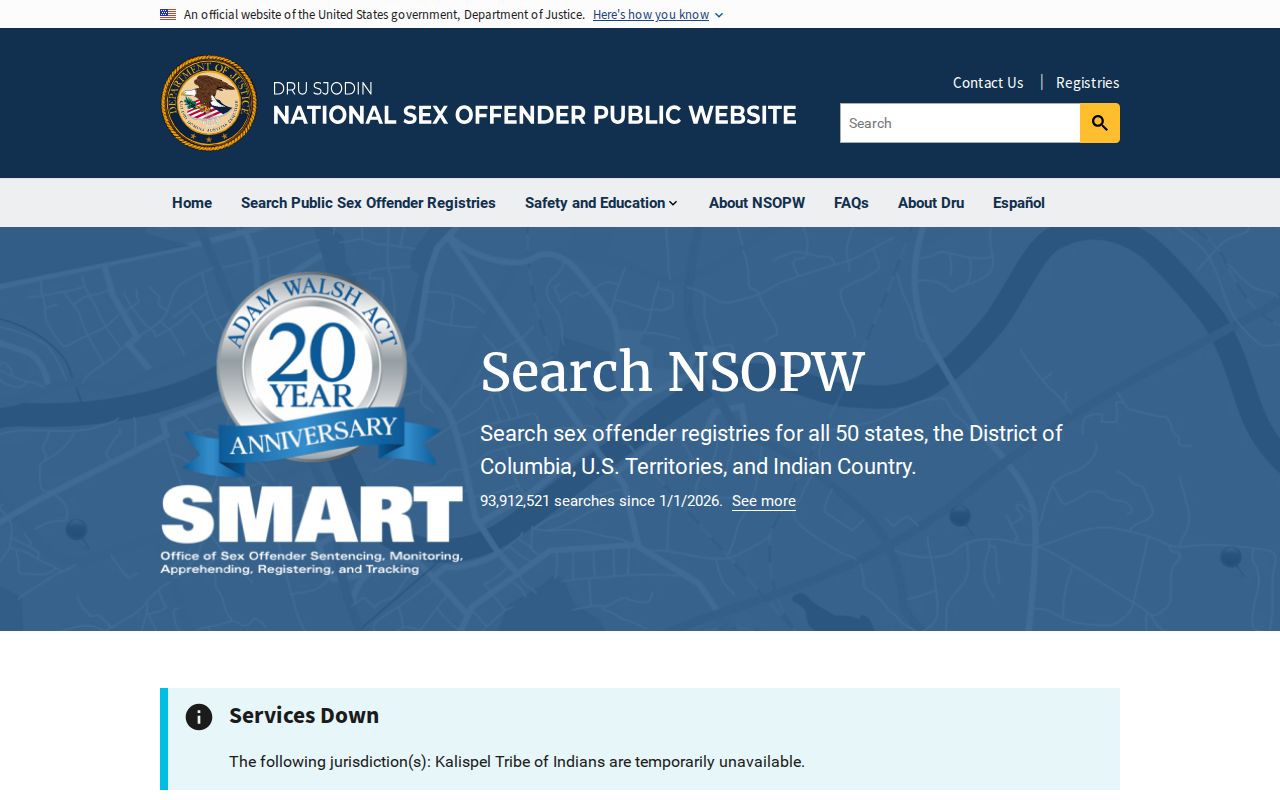
The national search image marks the broader route for a check that cannot safely stop at the Nacogdoches County boundary.
When NSOPW returns a Texas record, return to the DPS profile for the state's current public details and local registration authority. A no-result search remains limited by the criteria used, participating source data, and legal restrictions. It should not be treated as proof that no registration record exists anywhere.
Registry Profiles: What They Show
A Texas public profile can include the registered name, aliases, photograph, physical descriptors, birth information at the public level, registered address or location, registration status, risk level where assigned, verification information, reportable offense, and conviction or adjudication data. Victim age category and qualifying vehicle information may also appear when public. Read these fields as one record, since a name alone is a weak identity match.
| Name and aliases | Shows the public identity names tied to the registration record. |
|---|---|
| Photo and descriptors | Can include photograph, sex, race, height, weight, hair, eyes, and allowed birth information. |
| Registered location | Displays the public address or location information permitted for the record. |
| Reportable offense | Identifies the qualifying offense and public conviction or adjudication information. |
| Risk and duty details | May show risk level, registration status, verification information, and duration-related facts. |
| Other public facts | Can include public victim age category and qualifying vehicle information. |
DPS does not expose Social Security numbers, driver's-license numbers, phone numbers, online identifiers, victim-identifying information, or other protected contact data. A juvenile court can order juvenile registration information nonpublic. Those limits protect sensitive details and should not be treated as missing profile errors.
Note: A public registry profile contains notification data, not every criminal case document or every element of a Texas criminal history.
Reading Nacogdoches Registry Results Carefully
A photograph, alias, address, and status should be checked together. A past offense explains the registration basis, while the current status and verification data address present compliance. A registered location is not a claim about everyone else at that address. Victim age information, where public, does not identify the victim and must never be used to speculate about identity.
DPS's registry and criminal-history FAQ explains the program's public scope and distinctions. The captured FAQ source supports careful use of the registry rather than treating it as the Texas DPS conviction name-search product.
Review the official DPS registry FAQ source.
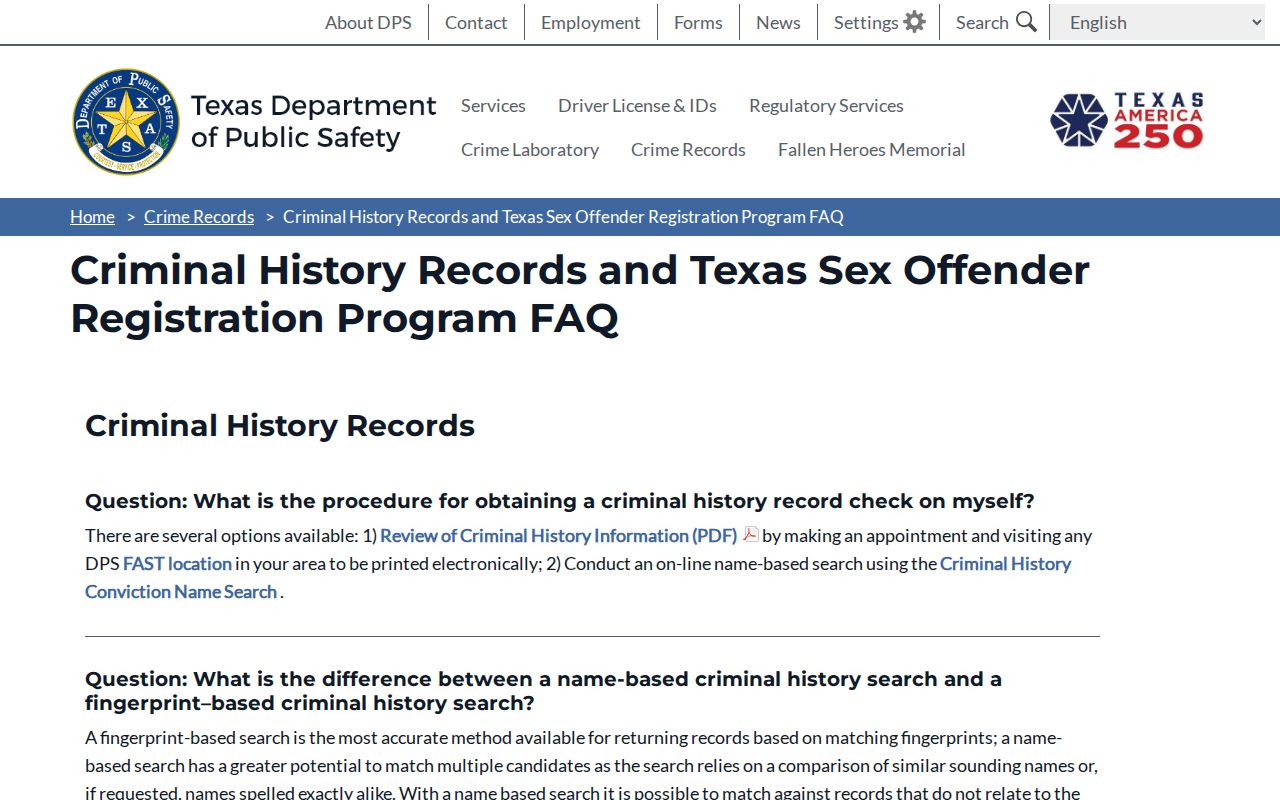
The FAQ image reinforces that a registry result has a defined notification purpose and a limited set of public fields.
Registration Levels and Duties in Texas
Texas registration duration is generally ten years after discharge from incarceration, parole, or community supervision, or lifetime, depending on the reportable offense and statutory circumstances. It is inaccurate to force Texas duties into a generic federal Tier I, II, or III chart. Texas also uses low, moderate, and high risk assessments for notification-related purposes. A risk label is distinct from the offense-based rule that sets registration duration.
| Texas category | General duration | Key qualification |
|---|---|---|
| Adult offense assigned a ten-year duty | Ten years after discharge from custody, parole, or community supervision | Confirm the exact Chapter 62 offense and rule |
| Sexually violent and other lifetime categories | Lifetime | Applies to qualifying statutory offenses and circumstances |
| Juvenile registration | Statute and court dependent | A juvenile court may restrict public access |
| Extrajurisdictional registrant | Depends on Texas and outside duties | DPS determines substantial similarity |
The controlling rules are in Code of Criminal Procedure Chapter 62. Exact offense, adjudication, age, and external-jurisdiction facts can change the result, so the profile and statute should be read together rather than using the risk label as a duration calculator.
Nacogdoches Registry Alerts and Postcards
The DPS registry includes a notification signup function for residents who want official updates. Community notification also occurs through the public database, local registries, and notices required by Texas law. DPS describes English and Spanish postcard notification when a civilly committed sexually violent predator or high-risk registrant moves into a community.
The Texas Sex Offender Registration Program overview explains state and local roles. Its source image provides context for notification and registration duties.
See the official Texas registration program source.
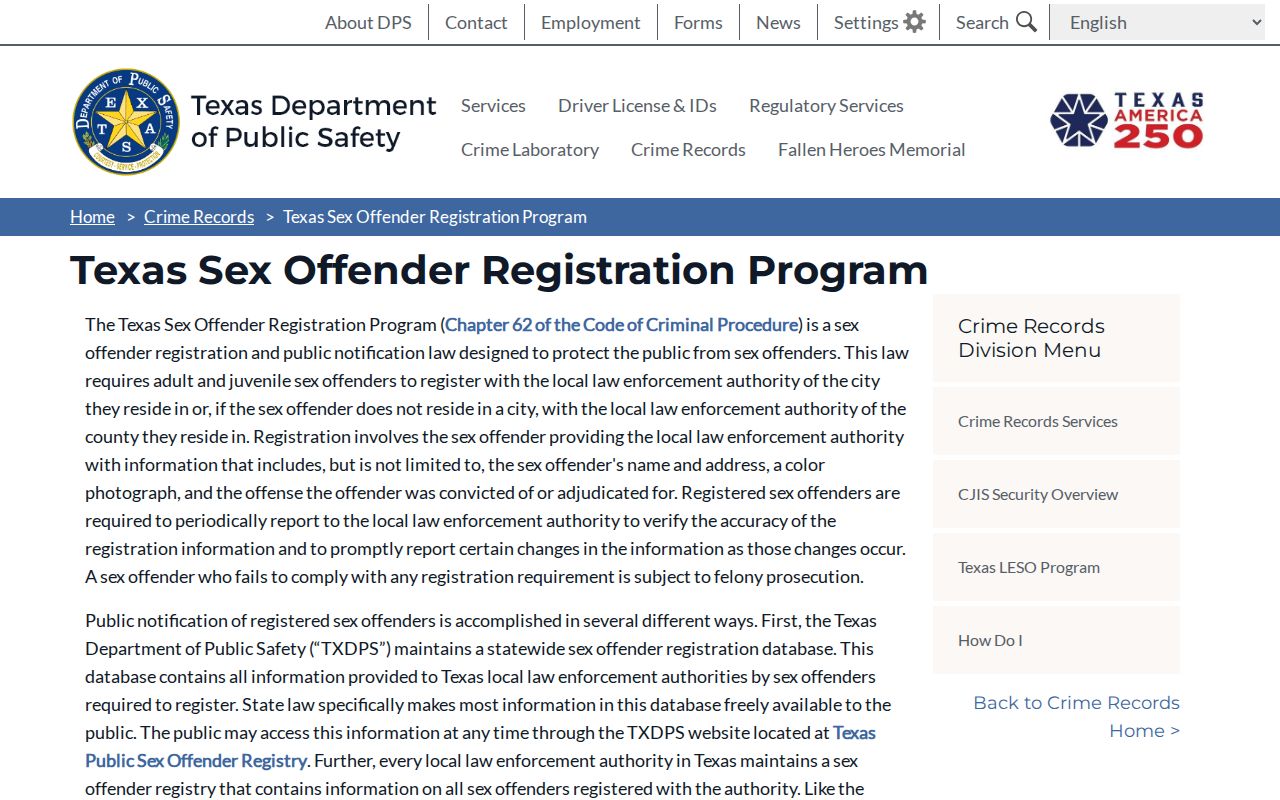
The program image links public search results to the local verification and state publication process behind them.
Using Registry Information Lawfully
Registry information supports personal, family, and community safety planning. It does not authorize confrontation. Harassment, threats, discrimination, trespass, or vigilantism can violate Texas law and can place residents and officers at risk. Use the public facts to make calm safety choices, and direct a suspected violation to the proper registration authority.
Misuse is unlawful: Do not use Texas registry data to harass, threaten, intimidate, trespass, or take vigilante action. Review Texas Code of Criminal Procedure Chapter 62 and the registry's current warning.
Within Nacogdoches city, report suspected noncompliance to the city registration authority or law enforcement. For an unincorporated Nacogdoches County location, contact the Sheriff's Office. Program questions can go to the DPS Sex Offender Registration Unit. Do not approach the registrant or household, publish protected details, or infer wrongdoing from a neighbor's presence at a registered address.
Reporting Nacogdoches Registry Noncompliance
Begin by recording the public profile URL, the status or address detail that appears inconsistent, and the date of the observation. Avoid collecting private identifiers or entering private property. Call the local registration authority that covers the address. Nacogdoches Police handles city registration administration, while the Sheriff's Office handles the unincorporated county role described by DPS.
The county's official website and directory can confirm current contact routes. The county public-information request page is for existing county records, not emergency reporting or a request for officers to investigate on demand. If a situation presents immediate danger, use the appropriate emergency channel rather than a records request.
For a possible cross-state issue, compare the DPS profile with NSOPW and contact the responsible jurisdiction. Report facts, not conclusions. The registration authority can determine whether the record is stale, the person is within a reporting window, or a compliance inquiry is warranted.
Note: Preserve the search date and profile details, then let the proper registration authority assess any possible violation.