
Criminal Court Cases in Nacogdoches County
Nacogdoches County criminal court cases are divided by charge level. The 145th and 420th District Courts hear felony matters, and the District Clerk preserves those files. Both district courts serve Nacogdoches County from the courthouse at 101 West Main Street. The County Court at Law handles Class A and Class B misdemeanor prosecutions, with the County Clerk serving as file custodian. That split determines where a reader asks for the charging instrument, docket, judgment, or certified copy.
Fine-only cases follow a different route. Municipal courts keep city ordinance and fine-only misdemeanor files, while justice courts retain precinct matters and perform magistrate functions. Nacogdoches Municipal Court publishes its own procedures, Garrison maintains a municipal court page, and Cushing inquiries begin with City Hall. Searching only the District Clerk can therefore miss a valid local case. The current county directory is the safest place to confirm the correct clerk and current office contact before visiting.
Note: A booking charge identifies the allegation at intake, while the clerk's file shows the charge prosecutors chose to file.
Choosing a Nacogdoches County Criminal Court
The offense class is the most useful routing clue. Texas Penal Code Chapter 12 places capital, first-, second-, third-degree, and state jail felonies in district court. Class A and B misdemeanors are handled in the County Court at Law. A Class C misdemeanor is generally a fine-only matter for a municipal or justice court. Enhancements can change the range, so the final charging instrument and judgment carry more weight than the label shown at booking.
The Texas Judicial Branch court directory shows the Nacogdoches courts and is useful for confirming the court level. The official directory view captured for this project also helps distinguish the two district courts from the lower courts.
View the official Nacogdoches court directory source.
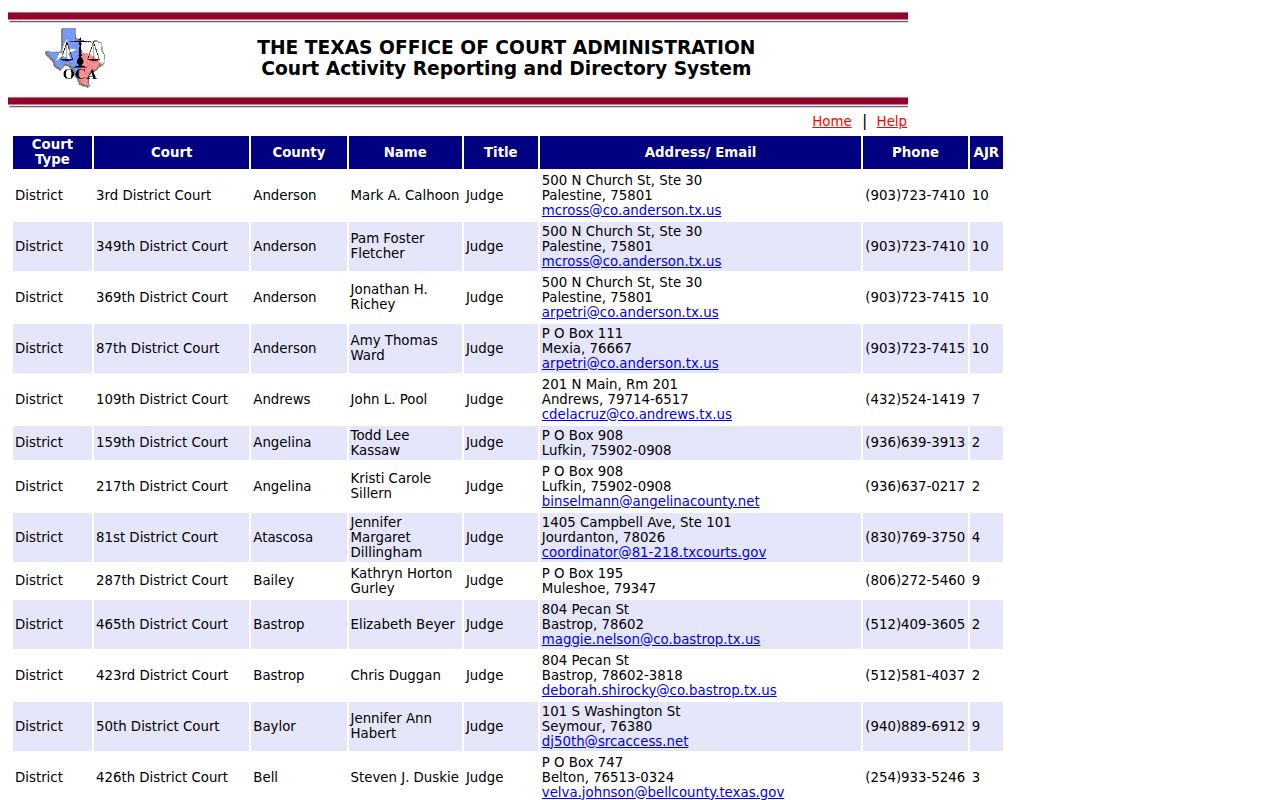
The directory image is a routing aid, not a substitute for the docket or documents maintained by the proper Nacogdoches County clerk.
Nacogdoches County Case Record Searches
A cause number is the strongest search key because it points to one case and court. If only a name is known, provide spelling variants and a filing-date range. Start with re:SearchTX, then use the relevant clerk's index, counter, phone channel, or written request if the statewide platform lacks the file. Ask separately about an index search, electronic document access, plain copies, and certified copies. The research did not locate a stable current local fee schedule, so obtain a quote before ordering.
- Identify whether the matter is a felony, Class A or B misdemeanor, municipal citation, or justice-court case.
- Search by cause number when available. Otherwise, use the full party name, spelling variants, and a likely filing period.
- Confirm the court, case type, filing date, and status before treating a result as the intended file.
- Read docket entries in date order and locate the filed charge, plea, disposition, judgment, and sentence.
- Ask the custodian about inspection, electronic access, a plain copy, or a certified copy based on the intended need.
The statewide search exposes only what participating clerks make available for the user's access level. These fields are the practical identifiers to enter or verify, even when the live interface presents them in a different order.
| Search detail | Type | Best use | Access note |
|---|---|---|---|
| Cause number | Identifier | Direct case match | Most reliable clerk key |
| Party name | Text | Name-based search | Try spelling variants |
| Court or case type | Filter | Narrow the jurisdiction | Separate felony, misdemeanor, and fine-only files |
| Filing date or year | Date filter | Reduce same-name results | Use a range when the exact date is unknown |
| Document image | Result feature | Read the filed document | May require an account, fee, or clerk purchase |
re:SearchTX and Nacogdoches Court Cases
re:SearchTX is the official statewide court-record platform, but Texas does not have one uniform, free trial-court index containing every Nacogdoches County criminal case and document. Participation, user role, account status, and a clerk's publication choices affect what appears. A result can provide court metadata or docket information without offering every document image.
No online result should be read as proof that no case exists. A recent jail charge may not yet have reached the clerk, the matter may belong to another court level, or the local file may not be exposed remotely. When re:SearchTX falls short, contact the District Clerk for a felony, the County Clerk for a Class A or B misdemeanor, or the municipal or justice court for a fine-only file. The county's Public Information Request entry point is useful for county-held executive records, but judicial records can follow court-specific access rules.
Access point: Remote court data is a starting point. The file custodian remains the authority for certification, redaction, and missing documents.
What a Criminal Case File Contains
A Nacogdoches County court case file records the prosecution rather than the arrest alone. Its header ties the cause number to a court, filing date, status, and judge. The charging instrument identifies the count, alleged offense, statute, and degree or class. Counsel, bond activity, settings, motions, hearings, plea, judgment, sentence, costs, and post-judgment entries can appear as the case progresses. Availability varies, and confidential details may be removed from a public view.
| Cause number and court | Connects the record to one Nacogdoches County court and supplies the best request key. |
|---|---|
| Charging instrument | Shows the filed counts, statute, offense date, and degree or class, including any alleged enhancement. |
| Docket entries | Lists complaints or indictments, capias activity, settings, motions, pleas, judgments, and later case events. |
| Hearings | May identify the date, time, courtroom, event type, and judge for a setting. |
| Disposition and judgment | Shows whether the filed matter ended in conviction, dismissal, acquittal, deferred adjudication, transfer, or another result. |
| Sentence and finance | May state confinement or community supervision, fines, costs, restitution when public, and balances. |
| Documents and redactions | Indicates image access, certification, and removal of protected identifiers, victim data, or confidential material. |
The court file should be compared with the Nacogdoches County arrest search by name, date, agency, and identifiers. The two records describe different stages.
Reading Nacogdoches Criminal Case Events
Docket events are best read as a timeline. An indictment is a formal accusation, not proof of guilt. A capias is a court-issued command to take a person into custody. A plea records the defendant's response to the charge. A disposition marks the court's outcome event, but the word “disposed” alone does not tell whether the result was a conviction.
- Deferred adjudication
- A court postpones a finding of guilt while the person completes court-ordered supervision; it is not the same as an immediate dismissal.
- Dismissal
- The filed charge ends without a conviction on that count, but separate booking or agency records do not automatically vanish.
- Judgment
- The signed court record states the adjudicated result and, when applicable, the sentence.
- Revocation activity
- Later docket entries address an alleged violation of community supervision or another conditional status.
A later expunction under Chapter 55A or an order of nondisclosure under Government Code Chapter 411 can change public visibility. It does not mean every independent system updates at the same moment. If a DPS public history lacks the court's final disposition, the reporting clerk and DPS personal-review process are the proper correction path.
Note: “Disposed” means that the court recorded an outcome event; the disposition field and judgment reveal what that outcome was.
Criminal Case Stages in Nacogdoches County
A Nacogdoches County prosecution begins after an arresting agency and prosecutor generate the facts and filing decision needed for court. The charge at jail intake may change before a complaint, information, or indictment reaches the clerk. Once filed, arraignment places the charge and plea before the court. Pretrial activity can include counsel appearances, bond issues, discovery, motions, and settings. A plea or trial leads to a disposition, followed by sentencing when the outcome requires it.
Case flow: Charges Filed → Arraignment → Pretrial → Plea or Trial → Disposition → Sentencing
Each stage adds a new docket entry or document. The clerk's date-stamped sequence helps explain why the offense description, bond conditions, or case status seen later may differ from the first jail entry. It also prevents a hearing setting from being mistaken for a completed judgment.
When a Nacogdoches Court Charge Is Missing
A person can appear on the county jail roster before the court case is searchable. Booking happens first, while prosecutor review and clerk filing follow. A no-result search may also reflect a spelling variation, wrong court level, incomplete date range, delayed electronic publication, or a case maintained only through the clerk. Check the roster timestamp, identify the arresting agency, and record the charge as alleged at booking without assuming it became the filed count.
Next, ask the proper Nacogdoches County clerk whether an index search can be run by name and date. For a city citation, call the municipal court rather than the district clerk. For a justice-court matter, use the correct precinct. If the issue is a missing statewide disposition, compare the judgment with the Texas DPS criminal-history reporting chain under Code of Criminal Procedure Chapter 66.
Note: A missing remote result can reflect timing or jurisdiction, so confirm through the clerk before drawing a conclusion.
Access Rules for Nacogdoches Case Records
Public access depends on the record and custodian. The Texas Public Information Act governs public information held by governmental bodies, but court records can also fall under judicial-record rules rather than the executive-branch request process. Government Code Section 552.221 requires prompt production of covered public information. It does not promise that every judicial document will appear online or that every request will be completed within one fixed number of days.
Social Security numbers, protected victim information, juvenile records, and other confidential details may be restricted or redacted. Family Code Chapter 58 limits juvenile justice information. A clerk may offer a public docket while withholding a protected image, or may require a copy fee for a document available at the counter. Ask what is inspectable, what must be ordered, whether electronic delivery is available, and what certification costs before paying.
Government Code Chapter 411 separately controls dissemination of criminal-history record information held by DPS. A public DPS name match is not the same record as a public Nacogdoches County court judgment, and neither should replace a fingerprint-based personal review when identity is disputed.
Federal Cases Outside Nacogdoches County
Nacogdoches County lies within the U.S. District Court for the Eastern District of Texas. Federal prosecutions are not filed in the Nacogdoches County clerk indexes. The federal court maintains its own docket, and the official access route is PACER. PACER requires registration and applies the judiciary's current fee and quarterly-waiver policy, which should be checked on the live service.
See the official Eastern District of Texas source used for the federal court layer.
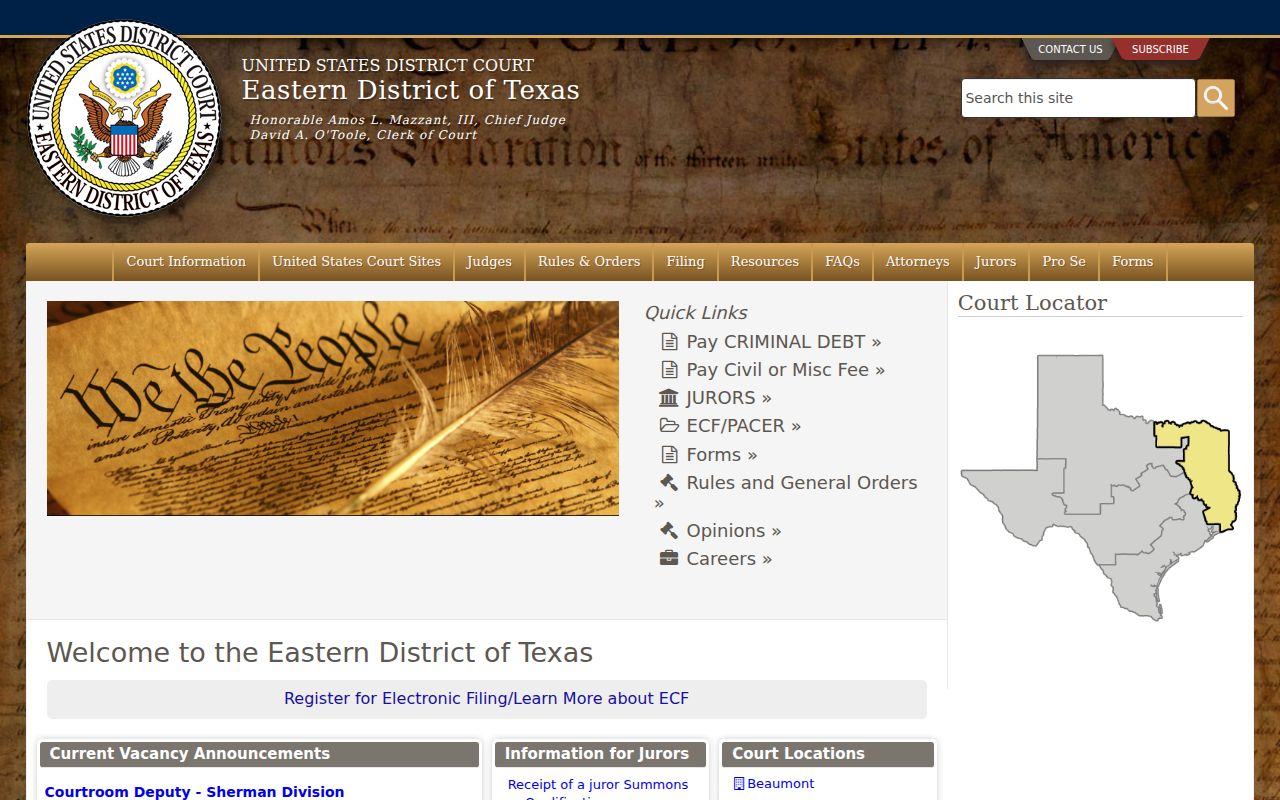
The Eastern District image marks the separate federal jurisdiction that a county-only case search will not reach.
Review the official PACER access source.
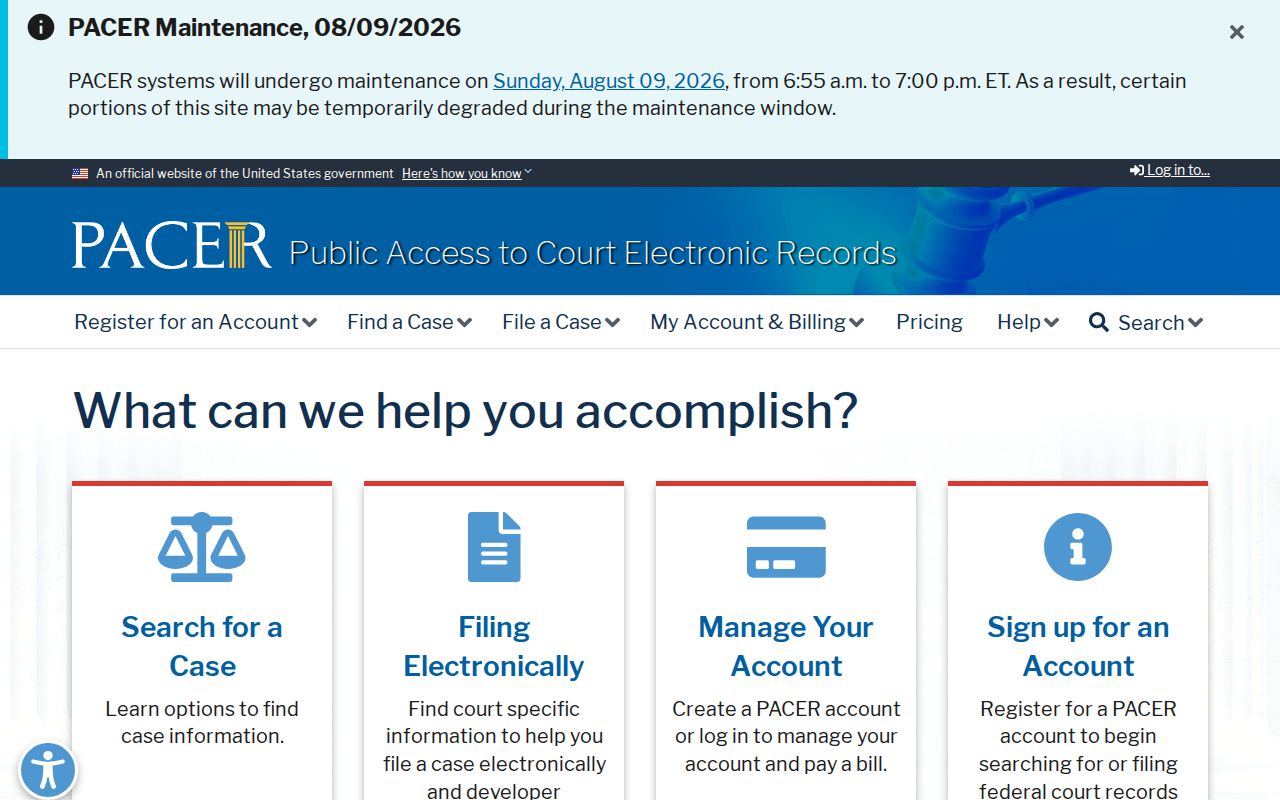
The PACER image shows the official federal docket route, distinct from local clerk access and re:SearchTX.